Green Wing and Suddenly All Was Right With the World Again
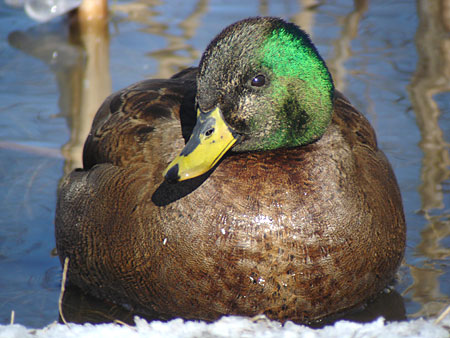 Confusing Domestic Ducks (and hybrids)
Pictures taken with an Olympus D-450, D-xl, or Sony Sureshot digital photographic camera through a Swarovski HD80 or Swarovski AT80 spotting scope.
All photos � Kevin and Jay McGowan, unless otherwise noted.
Odd Ducks
Past Kevin J. McGowan
(Kickoff published in the Cayuga Bird Order Newsletter, February and March 2006)
What is that strange looking duck? It doesn't expect familiar, and y'all can't find it in your field guide.
Waterfowl tin can exist fun for beginning birders because they are relatively easy to watch, not flitting through the trees or into the bushes like trivial dicky birds. They have very distinctive plumages with large patches of color in bold patterns that make identification relatively easy. True, the female person dabblers all wait pretty much alike, but the males are distinctive. So what do you do when y'all run up confronting something you can't identify and can't detect in the books? How tin you effigy out what it is?
Duck identification problems often autumn into ane of but a few categories. In this article I will attempt to explain some of them and give common examples of each.
It'south a domestic duck.
This is probably the most mutual answer to most beginning birder'south duck issues. Domestic duck breeds are not illustrated in nearly field guides, and the older guides did not mention this trouble at all. When people go out looking for wild birds they seem to forget that domestic breeds exist. Outset rule of thumb: If your weird duck is found at a park, walking effectually on the grass or coming near people, it is probably a domestic duck. But, these domestic monsters practice get mixed up in flocks of wild birds, too, so how practise you lot spot them? Second rule of thumb: If your duck has large patches of white where yous didn't await information technology, call up domestic duck. People seem to love to breed white or partially white domestic animals, presumably because such mutations don't practice well in the wild and consequently are rare. Such mutations do turn up in the wild, though, and we'll discuss them later, but for at present, if yous run across big patches of white, retrieve domestic duck.
Only 2 species of ducks take been domesticated: the Mallard (Anas platyrhynchos) and the Muscovy Duck (Cairina moschata).
Permit's deal with the Muscovy Duck first, as it'south pretty easy to tell. The almost obvious character of a muscovy is the red facial skin. If your duck has a red confront, information technology'due south probably a Muscovy Duck. This carmine pare tin can exist quite bumpy, exaggerated, and frankly, gross, with a knob on top of the bill and lumps all over. If you run into that, it's a slam dunk Muscovy Duck. The wild type plumage of muscovy is all black, glossy dark-green on the back, and with large white wing patches. Only, because of our fondness for white, domestic muscovies tin exist pure white, all black, or any degree of pied black-and-white. 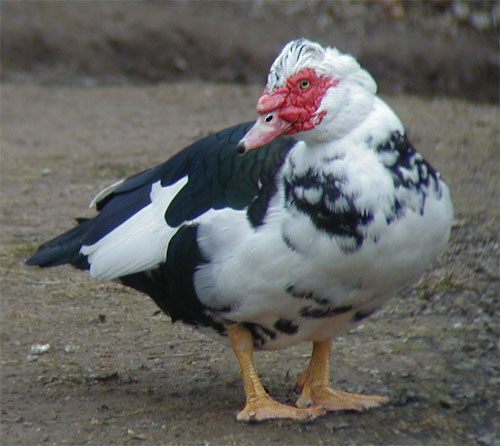
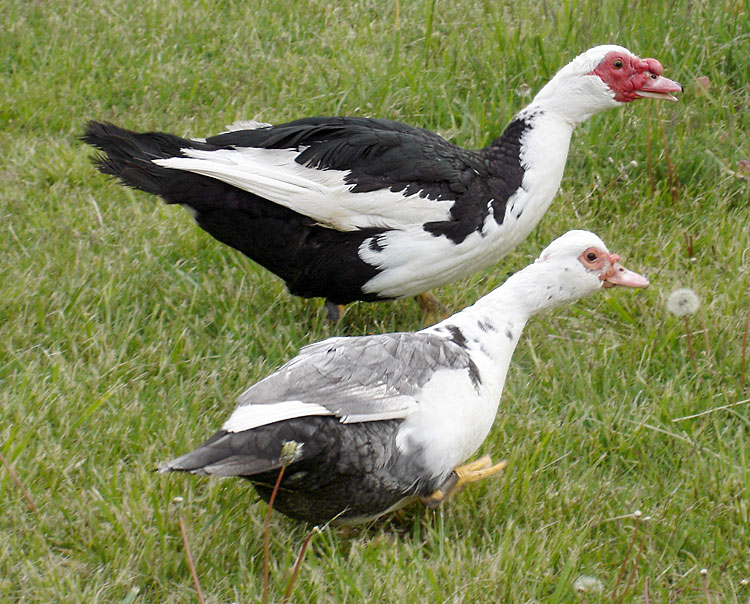
Mallard breeds can be somewhat disruptive. They can be larger than normal or much smaller, darker or lighter, all white or all black. Lookout man for the picayune curled feathers on the back of the male, above the tail. Merely the Mallard and its domestic descendants take those. (Well, the Hawaiian Duck does too, but the chances of seeing one of those around here is about nil.)
Once more, lots of white is often involved, including all-white breeds like the popular Pekin Duck. Another mutual grade is the bibbed version. It has a sort of normal body and head plume, and a white chest. Other forms and crosses tin have spots of white just nigh anywhere. Unremarkably these white spots are not symmetrical across both sides, and that asymmetry should tip you off to think domestic influence.
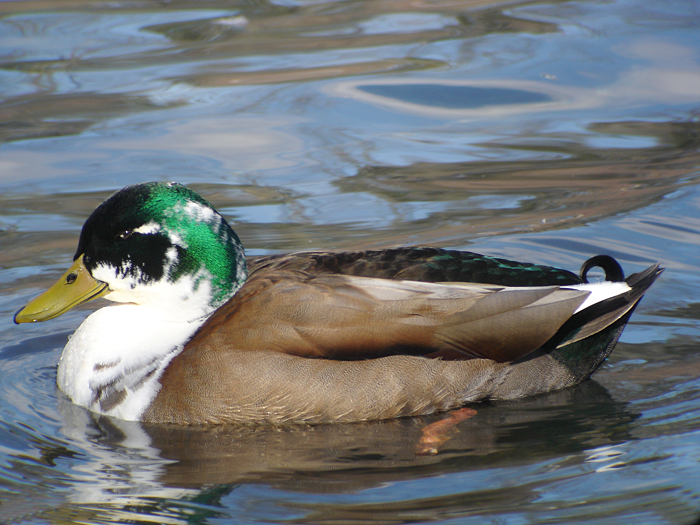
This bibbed domestic Mallard was in Union Springs, Cayuga Co., NY, 19 February 2006.
The passion for weird plumage in domestic ducks does not terminate with white, but can go the other way too. Some breeds are darker than normal Mallard plumage. One popular nighttime breed is known as the "Cayuga Duck," and it may accept actually originated in our surface area (key New York) in the 19th century. This duck is dark all over and rather irised, like its shiny speculum feathers got spread over the entire bird. Very handsome, indeed. Other color variations include faded and stake versions of normal ("apricot," "buff," or "fawn"), somewhat darker and without the white cervix ring ("dusky"), or faded silvery ("blue"). There are lots of other weirdnesses too, including topknots and strange, barbless feathers, but I'd rather not get into them. Just be aware that very odd things exist in the world of domestic poultry, and oddity should make you consider domestic origin.
Body size tin often exist a inkling toward domesticity. The offset breeds of domestic Mallard were bred for food, and consequently for big trunk size. A domestic duck can be twice the size of a wild Mallard. Even if they're non obviously larger, they tend to be bulkier and more dumpy looking, especially in the belly. But, domestics can be smaller than normal too. Indian runner ducks are long and lean. These are very odd, tall, skinny ducks that look like bowling pins. They are great egg producers but have totally tubular bodies.The pygmies of the domestic duck world are the "Call" ducks. Telephone call ducks are tiny, teal-sized things that accept smaller bills and more rounded heads than normal ducks. That ways they're cuter. They were originally bred equally live decoys to attract or "call" wild ducks in to be shot, and are notwithstanding sometimes known as decoy ducks. They can have normal Mallard plumage, white, faded, or dark. Males volition withal have the curled tail feathers and the plumage will more often than not fit in the aforementioned basic categories every bit the other Mallard types. The recent call duck hanging out at Marriage Springs, NY is a male (with some problems), and tin can be recognized by his cute look, curled tail feathers, "dusky" coloring, and the fact that he'due south in love with a female Mallard.
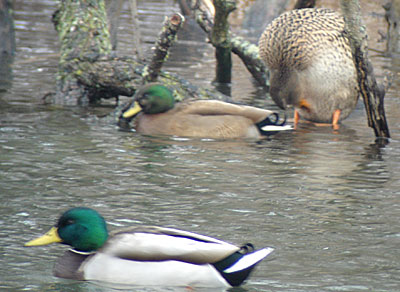
This dusky telephone call duck was in Union Springs, Cayuga Co., NY, 27 December 2005.
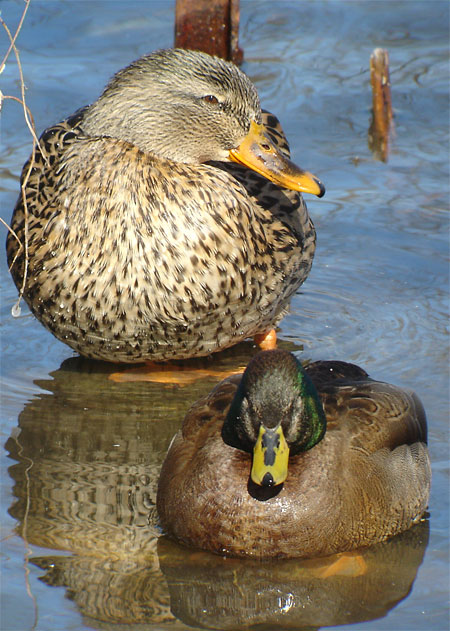
This dusky telephone call duck was in Union Springs, Cayuga Co., NY, xix February 2006.
I t's an exotic duck.
Ducks are good fliers, and some fly long distances in migration. That means sometimes we get European or Asian ducks turning upwardly in North America. Such an occurrence is pretty rare, though, and the few species that do this are mostly illustrated in the field guides. More frequently than that, we find escaped "pet" ducks. Keeping ornamental waterfowl is very popular. It can be surprising how many people have captive ducks and geese. Sometimes these ducks go loose, and sometimes their owners get rid of them by turning them out on a swimming or lake. The all-time local examples of this phenomenon are the Mandarin Duck pair that was at Myers Point, Lansing, NY briefly in January 2003, and the Red-crested Pochards (and hybrid) that put in an appearance at that place many years agone. Although owners of domestic ducks are supposed to put bands on their birds and clip off the hind claw on each foot, that doesn't seem to happen all that often, and birds are out there without these marks of captivity. Ane mark that seems to show upward more oftentimes is pinioning, where the tip of one wing is surgically removed to keep the bird from flight. When pinioned ducks flap, you can come across the one-half-a-fly pretty clearly (every bit was the case with the aforementioned pochards). A number of guides to all of the ducks of the world are available, so a quick browse through one of them might discover your odd duck. If not, effort one of the other possibilities.
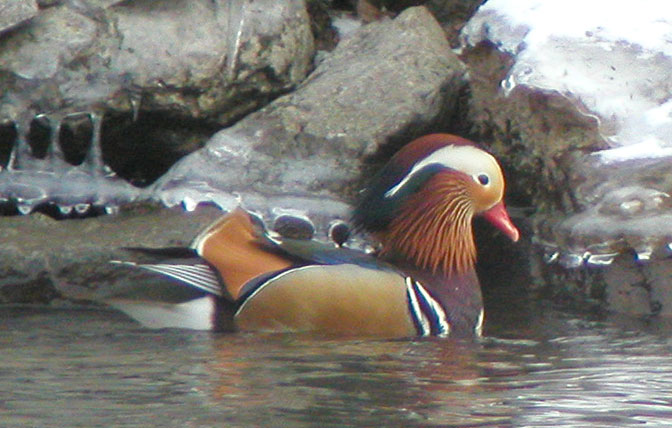
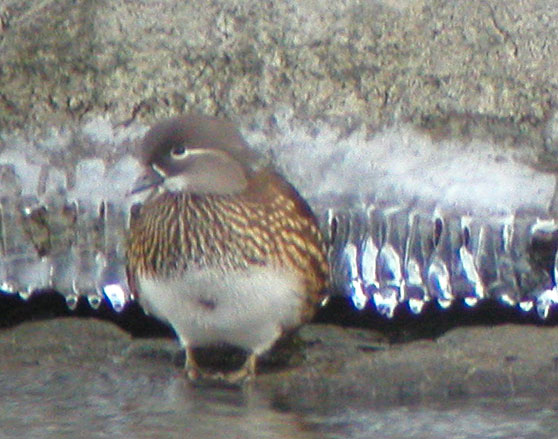
This pair of Mandarin Ducks was seen in the marina at Myers Indicate, Tompkins Co., NY, xvi January 2003.
Information technology'due south a hybrid duck.
Male person ducks provide no parental intendance, and female ducks do not have to feed their young, simply lead them effectually. (Which is why male person ducks tin can become away with not helping.) This situation tin can pb to careless sex and consequently hybridization. Although hybrid ducks are not that common overall, they do occur on a regular basis.
The most common in central New York are Mallard X American Black Duck hybrids. (It turns out that most females of the Mallard close relatives discover a green caput actually sexy, and they will hook upwards with Mallard males whenever they are available. Such propensities create some conservation concern when domestic Mallards are introduced into the range of some other species, such equally American Blackness Duck or Mottled Duck.)
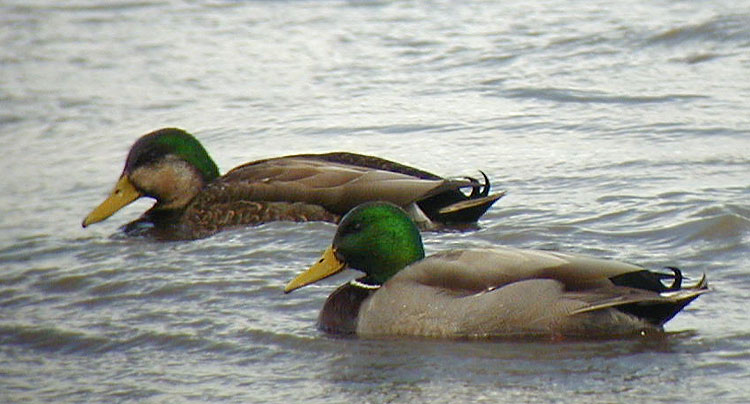
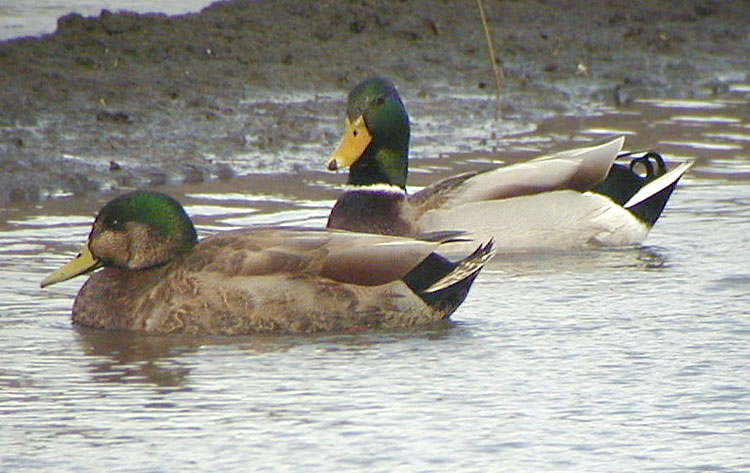
These two different Mallard X American Black Duck hybrids were with Mallards at Stewart Park, Ithaca, NY, 24 March 2001. Annotation that one has the curly upper tail coverts like a Mallard and the other 1 does not.
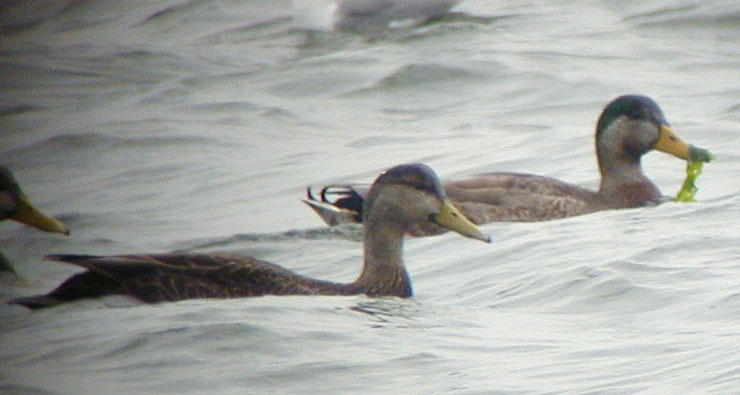
This Mallard 10 American Blackness Duck hybrid (in the rear) was with American Blackness Ducks at Point Spotter, Nassau Co., NY, three March 2001.
Sometimes the hybrid pairs are betwixt species that are not closely related, such equally Hooded Merganser X Common Goldeneye. In captivity where ducks from all over are housed together, anything can happen.
The clues for finding a hybrid are not then clear cut. The easiest style to spot them is when they have characters intermediate between the parental species. Look for a duck that looks familiar, but just doesn't look quite right. A black duck X Mallard male will ofttimes have the mostly tedious plume of the black duck and some green on the head. It may or may not accept the curled feathers over the tail, and the speculum can be blue like a Mallard or more purple like the black duck. Small green patches on the head tin be a proficient sign of some Mallard parentage. In general, spotter for symmetrical abnormalities, patches of color or lack of color.
Amongst the dabbling ducks sure patterns seem to occur in hybrids, even if they are not present in the parents. Pale cheeks and a Baikal Teal face up pattern tin outcome from a number of dissimilar pairings. Notation its presence, if faint, in the second Mallard X black duck pictured above.
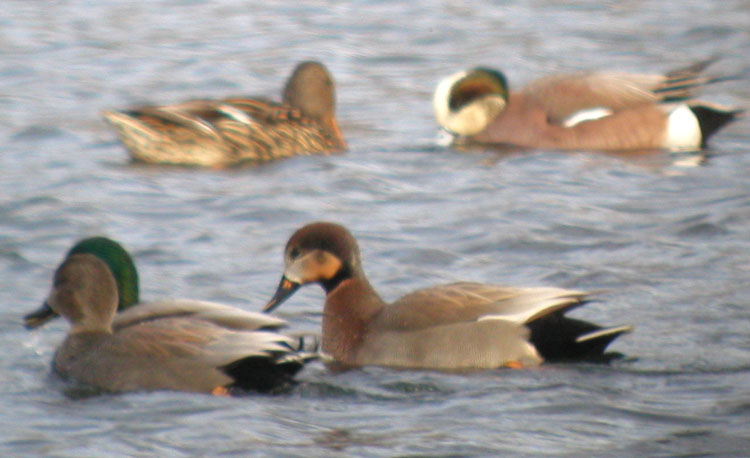
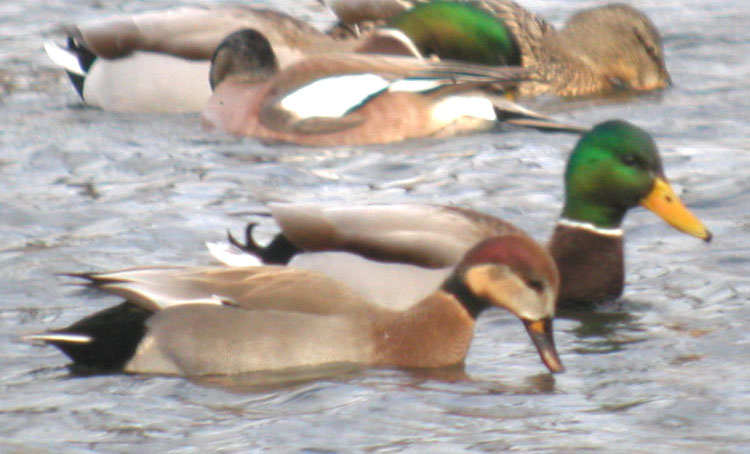
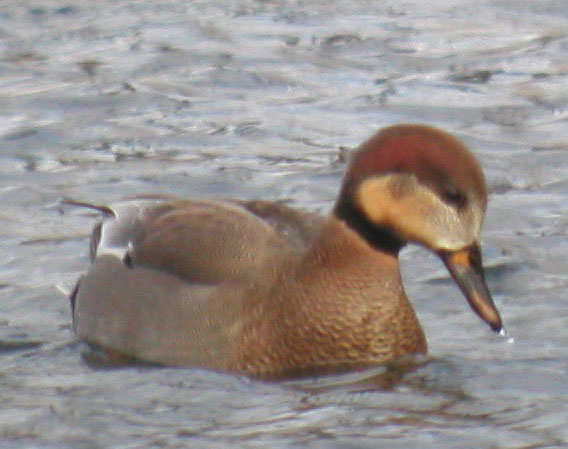
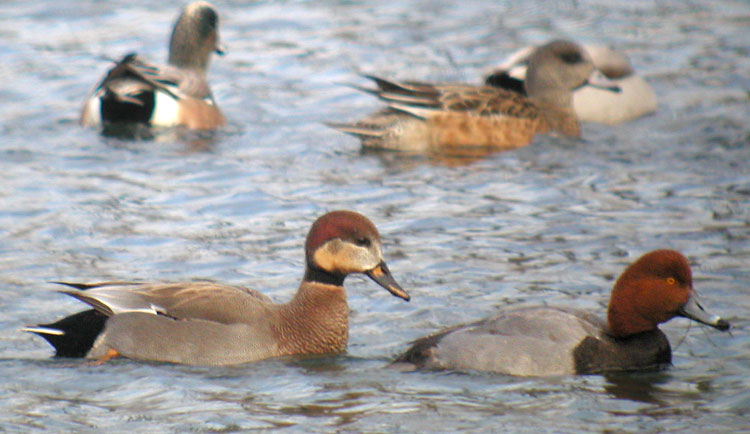
A recent hybrid duck in Union Springs, NY resembles a duck illustrated by Audubon and described as "Brewer's Duck." It has a dark cap with some greenish sheen, a pale to tan cheek, a dark neck ring, a lighter thin cervix band, a dark chest, nighttime sides, black rear end with a faint white stripe in front of it, and a whitish tail. Audubon thought that his bird might exist a cross between a Mallard and a Gadwall. The Spousal relationship Springs Brewer's Duck is very similar. The light-green on the caput, white tail, blackness rear finish, and pale neck ring are good Mallard characters. The greyness sides, dark rear end, and intricately patterned breast suggest Gadwall. Where the confront patch comes from is everyone's guess, and naught has a black-and-tan neb similar this bird. But does this bird accept Mallard in it? It looks very similar to a specimen in Gillham and Gillham (1996, Hybrid Ducks) that is labeled as Gadwall X Northern Pintail. It's difficult to know for sure, and Gillham and Gillhan (1996) give several known combinations that look like this duck.
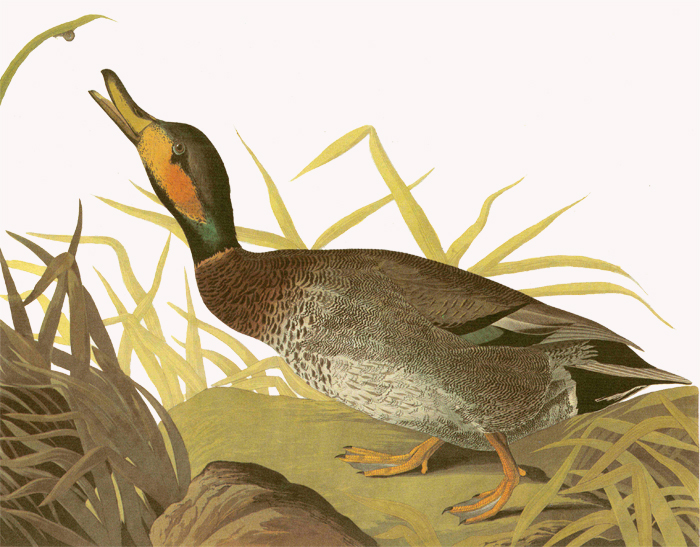
This is Audubon'southward painting of "Bemaculated Duck" or "Brewer's Duck." It has been accustomed as a Mallard 10 Gadwall hybrid.
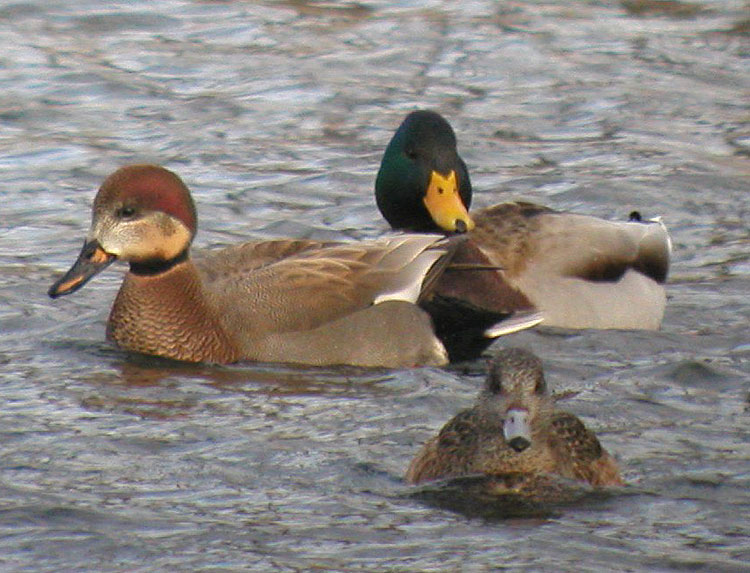
This Brewer's Duck look-alike was in Union Springs, Cayuga Co., NY, 13 February 2006.
I t's in eclipse plumage or transitioning out.
Dabbling ducks are unusual in that the males have a very briefly held drab plume in the summertime, known as an "eclipse" feather. It looks very female-like, but ordinarily a few characters are different. The transition dorsum to the classy nuptial plumage can accept a while, and the plume can be mixed. Transitional Mallards tin can look like hybrids with American Blackness Ducks. Transitional Northern Shovelers can evidence a Blue-winged Teal-similar white crescent on the confront. Light-green-winged Teal often show a mix of patterned female-similar and clean gray male feathers. The birds wait weird and might be mistaken for hybrids, but if y'all know such things exist you should be less surprised to come across such a mix of male and "female" characters.
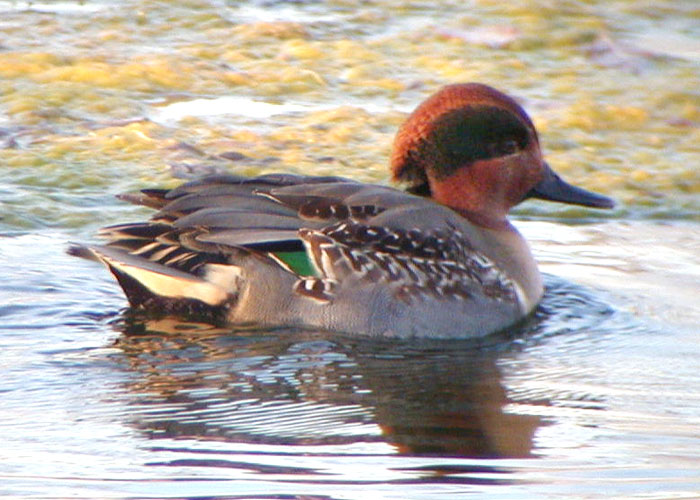
This transitioning Green-winged Teal was in Union Springs, Cayuga Co., NY, 22 Dec 2001.
It'southward a mutant duck.
Weird things happen in nature. Albinism and other color abnormalities are rather mutual. Odd, often irregular white patches can be a sign of partial albinism. It can exist hard to tell sometimes if a duck is a mutant or has domestic duck genes. Information technology is ever skillful to look at the shape and size of any suspect duck and see if it looks like the other, more than normally plumaged ducks around it. Third dominion of pollex: If it looks the aforementioned as the others ducks effectually it in every manner except colour (even behavior), then it probably is a mutant. Annotation also that Mallards and Muscovy Ducks unremarkably practise non swoop, so if your patched white duck is spending lots of time nether water, information technology'south a mutant.
| This female Redhead was in Union Springs, Cayuga Co., NY, 24 November 2000. |
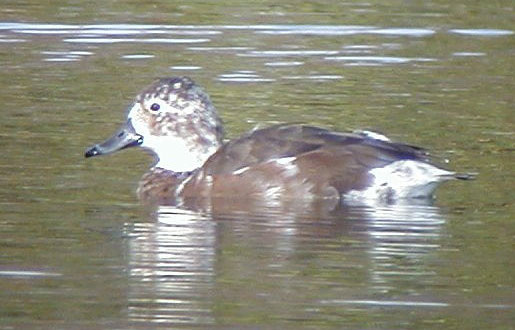
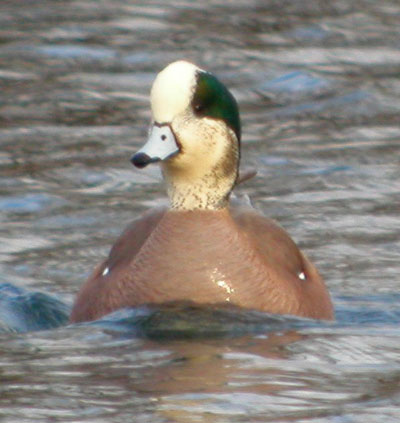
Some mutations or odd plumages aren't the result of albinism, but seem merely to be rare variations. The white neck ring on a male person Gadwall or the white cheeks on a male American Wigeon are examples that y'all can notice if you just look through plenty individuals.
| This white-cheeked American Wigeon was in Union Springs, Cayuga Co., NY, 13 February 2006. | This normal American Wigeon was at Montezuma NWR, Seneca Co., NY, 29 Oct 2005. |
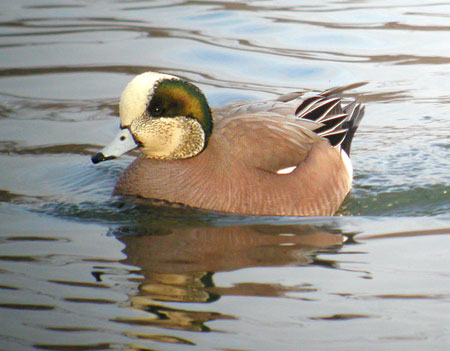
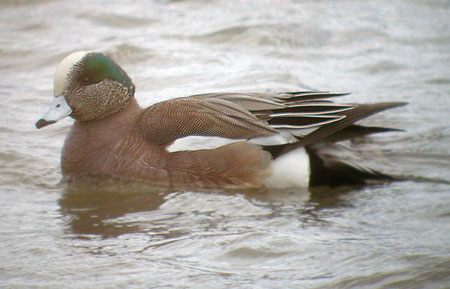
| This white-cheeked American Wigeon was in Matrimony Springs, Cayuga Co., NY, thirteen February 2006. | This normal American Wigeon was at Ithaca, Tompkins Co., NY, 13 March 2004. |
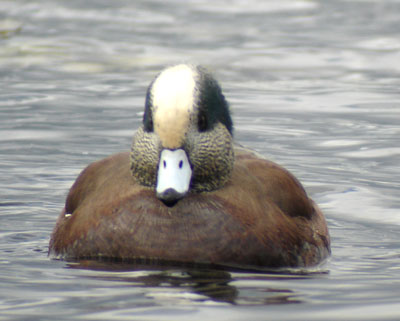
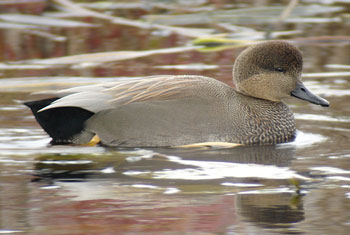
This normal Gadwall was at Montezuma NWR, Seneca Co., NY, 29 October 2005.
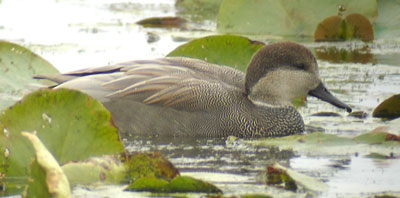
This Gadwall with a white hind cervix was at Montezuma NWR, Seneca Co., NY, 29 October 2005.
| This Gadwall with a white fore neck was at Montezuma NWR, Seneca Co., NY, 14 Apr 2002. |
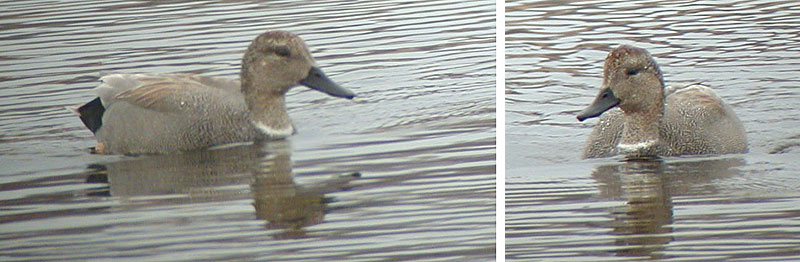
The bottom line to this article is that you lot can look to notice some ducks out there (as well as other birds, too) that merely do non look like anything in your books. And that's ok. Domestic ducks aren't that heady to me, and one time yous realize that most out-of-place waterfowl are escapees and non existent vagrants, they lose a niggling luster besides. But, they're still fun, and hybrids and mutants are rare plenty to become excited about. It also is gratifying to know that yous know the common things well enough that the oddities stand out. So get out and run across what you tin find.
Render to the Bad Photos page.
Return to Kevin McGowan's abode page.
Go to the Crow Page.
Revised: April 06, 2005 .
weinsteinwastfultaint.blogspot.com
Source: https://www.birds.cornell.edu/crows/domducks.htm
0 Response to "Green Wing and Suddenly All Was Right With the World Again"
Post a Comment