Forms of Art Literature Religious Faith and Social Organization
| Literature of Kingdom of spain |
|---|
| • Medieval literature |
| • Renaissance |
| • Miguel de Cervantes |
| • Baroque |
| • Enlightenment |
| • Romanticism |
| • Realism |
| • Modernismo |
| • Generation of '98 |
| • Novecentismo |
| • Generation of '27 |
| • Literature subsequent to the Civil War |

Cervantes's Don Quixote is considered the most allegorical work in the catechism of Spanish literature and a founding archetype of Western literature.
Spanish literature generally refers to literature (Castilian poetry, prose, and drama) written in the Spanish linguistic communication inside the territory that soon constitutes the Kingdom of Espana. Its development coincides and frequently intersects with that of other literary traditions from regions within the same territory, particularly Catalan literature, Galician intersects besides with Latin, Jewish, and Arabic literary traditions of the Iberian peninsula. The literature of Spanish America is an important branch of Spanish literature, with its own particular characteristics dating back to the earliest years of Spain'south conquest of the Americas (run into Latin American literature).
Overview [edit]
The Roman conquest and occupation of the Iberian peninsula commencement in the third century BC brought a Latin culture to Spanish territories. The arrival of Muslim invaders in 711 CE brought the cultures of the Middle and Far E. In medieval Spanish literature, the earliest recorded examples of a vernacular Romance-based literature mix Muslim, Jewish, and Christian culture. One of the notable works is the epic verse form Cantar de Mio Cid, composed some time between 1140 and 1207.[ dubious ] Castilian prose gained popularity in the mid-thirteenth century. Lyric poetry in the Centre Ages includes pop poems and the ladylike verse of the nobles. During the 15th century the pre-Renaissance occurred and literary production increased greatly. In the Renaissance important topics were poetry, religious literature, and prose.
In the 16th century the first Spanish novels appeared, Lazarillo de Tormes and Guzmán de Alfarache. In the Baroque era of the 17th century important works were the prose of Francisco de Quevedo and Baltasar Gracián. A notable writer was Miguel de Cervantes Saavedra, famous for his masterpiece Don Quixote de la Mancha. In this novel Cervantes consolidated the course of literature that the picaresque novel had established in Spain to a fictional narrative that became the template for many novelists throughout the history of Spanish literature.[ane]
In the Enlightenment era of the 18th century, notable works include the prose of Feijoo, Jovellanos, and Cadalso; the lyric of Juan Meléndez Valdés, Tomás de Iriarte and Félix María Samaniego), and the theater, with Leandro Fernández de Moratín, Ramón de la Cruz, and Vicente García de la Huerta. In Romanticism (get-go of the 19th century) important topics are: the poetry of José de Espronceda and other poets; prose; the theater, with Ángel de Saavedra (Knuckles of Rivas), José Zorrilla, and other authors. In Realism (terminate of the 19th century), which is mixed with Naturalism, important topics are the novel, with Juan Valera, José María de Pereda, Benito Pérez Galdós, Emilia Pardo Bazán, Leopoldo Alas (Clarín), Armando Palacio Valdés, and Vicente Blasco Ibáñez; poetry, with Ramón de Campoamor, Gaspar Núñez de Arce, and other poets; the theater, with José Echegaray, Manuel Tamayo y Baus, and other dramatists; and the literary critics, emphasizing Menéndez Pelayo.
In Modernism several currents appear: Parnasianism, Symbolism, Futurism, and Creationism. The destruction of Espana's fleet in Republic of cuba past the U.South. in 1898 provoked a crunch in Spain. A group of younger writers, among them Miguel de Unamuno, Pío Baroja, and José Martínez Ruiz (Azorín), made changes to literature's form and content. Past the year 1914—the year of the outbreak of the First World State of war and of the publication of the showtime major work of the generation's leading voice, José Ortega y Gasset—a number of slightly younger writers had established their own place within the Spanish cultural field. Leading voices include the poet Juan Ramón Jiménez, the academics and essayists Ramón Menéndez Pidal, Gregorio Marañon, Manuel Azaña, Eugeni d'Ors, and Ortega y Gasset, and the novelists Gabriel Miró, Ramón Pérez de Ayala, and Ramón Gómez de la Serna. Effectually 1920 a younger group of writers—generally poets—began publishing works that from their beginnings revealed the extent to which younger artists were absorbing the literary experimentation of the writers of 1898 and 1914. Poets were closely tied to formal academia. Novelists such as Benjamín Jarnés, Rosa Chacel, Francisco Ayala, and Ramón J. Sender were every bit experimental and bookish.
The Spanish Civil War had a devastating impact on Spanish writing. Amongst the handful of civil war poets and writers, Miguel Hernández stands out. During the early dictatorship (1939–1955), literature followed dictator Francisco Franco'south reactionary vision of a 2d, Catholic Spanish aureate historic period. By the mid-1950s, just as with the novel, a new generation which had only experienced the Spanish Civil War in babyhood was coming of age. By the early 1960s, Spanish authors moved towards a restless literary experimentation. When Franco died in 1975, the important work of establishing commonwealth had an immediate impact on Spanish letters. Over the next several years a wealth of immature new writers, amidst them Juan José Millás, Rosa Montero, Javier Marías, Luis Mateo Díez, José María Merino, Félix de Azúa, Cristina Fernández Cubas, Enrique Vila-Matas, Carme Riera, and afterwards Antonio Muñoz Molina and Almudena Grandes, would begin carving out a prominent place for themselves within the Spanish cultural field.
Pre-medieval literature [edit]
The Roman conquest and occupation of the peninsula, spanning from the 3rd century BC to the year 409 A.D, brought a fully adult Latin culture to Castilian territories. The Roman philosopher Seneca (i BCE-65 Advert) was built-in in Spain as were the poets Martial (41-104 AD), Quintilian (35-100 Advert), and Lucan (39-65 AD). While the invasion of Germanic tribes in the fifth century A.D. put an end to Roman Spain, the tribes' relative lack of avant-garde culture, including whatever kind of literary tradition, meant that whatever written literature produced in the Iberian Peninsula connected along Romanized lines. Outstanding among the works produced is Saint Isidore of Seville'due south (c. 560-636) Etymologiae, an attempted summa of all classical knowledge. Chosen "the last scholar of the ancient world", St. Isidore penned theological and proto-scientific treatises, letters, and a serial of histories that would serve as models for the residuum of Western Europe throughout the Eye Ages.
The arrival of Muslim invaders in 711 CE brought the cultures of the Center and Far East to the Iberian Peninsula and ultimately to all of Europe. During the era of relative religious tolerance that followed, writers such as the Jewish theologian Maimonides (1135–1204) or the Muslim polymath (1126–1198) Averroes penned works of theology, scientific discipline, philosophy, and mathematics that would have lasting impacts on Hebrew and Muslim philosophy and prove essential to the flowering of the European Renaissance centuries later. While none of their works can be considered directly ancestors of a Spanish literary tradition, it was out of the cultural milieu fostered past such intellectual energy that the showtime written manifestations of a Spanish literature proper arise.
Medieval Spanish literature [edit]
Andalusi literature [edit]
The menstruation of Islamic rule in Iberia from 711 to 1492 brought many new literary traditions to Spain. Almost literature at this time was produced in standard Arabic, though poesy and other forms of literature of the Jewish golden historic period institute expression in Judeo-Arabic or Hebrew. Maimonides, for case, wrote his magnum opus The Guide for the Perplexed in Arabic with Hebrew script.
Other major literary figures of the time include Ibn Arabi, Al-Mu'tamid ibn Abbad, Ibn al-Khatib, Ibn Zaydún and Hafsa Bint al-Hajj al-Rukuniyya.
Important literary styles include the muwashah, maqama, and nawba.
Important works include Hadith Bayad wa Riyad and The Incoherence of the Incoherence.
The kharjas [edit]
The earliest recorded examples of a vernacular Romance-based literature date from the same time and location, the rich mix of Muslim, Jewish, and Christian cultures in Muslim Espana, in which Maimonides, Averroes, and others worked. The Jarchas, dating from the 9th to the twelfth centuries C.E., were short poems spoken in local colloquial Hispano-Romance dialects, known equally Mozarabic, but written in Standard arabic script. The Jarchas appeared at the end of longer verse written in Arabic or Hebrew known as muwashshah, which were lengthy glosses on the ideas expressed in the jarchas. Typically spoken in the voice of a adult female, the jarchas express the anxieties of dearest, especially of its loss.
This combination of Hispano-Romance expression with Arabic script, just discovered in 1948, locates the rising of a Spanish literary tradition in the cultural heterogeneity that characterized Medieval Spanish society and politics. Nevertheless, the Mozarabic language of the Jarchas appears to be a split up Romance language whose evolution from Vulgar Latin paralleled that of Castilian Spanish rather than deriving from or fusing into the latter. Hence, while the relatively recent discovery of the Jarchas challenges pride of chronological place that belonged for so long to the Poema del Cid (El Cantar de mío Cid) (1140 CE) in the history of Spanish literature, they cannot be seen as a precursor to Spain's great epic poem. What the discovery of the jarchas makes clear instead is that from its origins, the literature of Spain has arisen out of and born witness to a rich, heterogeneous mix of cultures and languages.[2] [three] [iv]
Cantar de Mio Cid [edit]

The epic poem Cantar de Mio Cid was written about a real man—his battles, conquests, and daily life. The poet, name unknown, wrote the epic in about 1140 and Cid supposedly died forty years earlier in 1099. This epic represents realism, because nothing was exaggerated and the details are very real, even the geography correctly portrays the areas in which Cid traveled and lived. Different other European epics, the verse form is not idealized and there is no presence of supernatural beings. It has assonance instead of rhyme and its lines vary in length, the nigh mutual length beingness 14 syllables. This type of verse is known as mester de juglaria (verse class of the minstrels). The epic is divided into iii parts, besides known as cantos.
Mester de Juglaría [edit]
Medieval Spanish poets recognized the Mester de Juglaría as a literary form written by the minstrels (juglares) and composed of varying line length and utilise of assonance instead of rhyme. These poems were sung to uneducated audiences, nobles and peasants alike.
Mester de Clerecía [edit]
This Castilian narrative poetry known as the Mester de Clerecía became popular in the thirteenth century. Information technology is the poetry class of the learned poets, normally clerics (hence the name 'clerecía'). The verse was formal, with carefully counted syllables in each line. Pop themes were Christian legends, lives of saints and tales from classical artifact. The poems were recited to villagers in public plazas. 2 traits separate this grade from the mester de juglaría: didacticism and erudition. Gonzalo de Berceo was one of the greatest advocates of this school, writing on religious subjects.
Castilian prose [edit]
Castilian prose gained popularity in the mid-thirteenth century when King Alfonso X of Castile gave support and recognition to the writing form. He, with the help of his groups of intellectuals, directed the limerick of many prose works including Las siete partidas, the showtime modern book of laws of the country written in the people's language. Another work was La primera crónica full general which deemed for the history of Kingdom of spain from the creation until the end of Alfonso'south father's reign, San Fernando. For his direction of these works and many others he directed, Alfonso X is called the male parent of Spanish prose. His nephew, Don Juan Manuel is famous for his prose piece of work El Conde Lucanor which is a frame story or short stories within an overall story. In this work, the Conde Lucanor seeks advice from his wise counselor, Patronio, who gives the advice through the telling of stories. Juan Manuel also wrote lesser-known works such as El libro de los estados on the social classes and El libro del caballero y escudero on philosophical discussions. Toward the end of the Eye Ages, writer Fernando del Pulgar (1436-1490?) created a new type of prose named the verbal portrait. This class is demonstrated by Pulgar'southward piece of work Claros varones de Castilla in which he represents the detailed lives of twenty-four distinguished contemporaries. He explores their moral and psychological natures as well every bit concrete traits. Pulgar was the official historian of the monarchs Fernando and Isabel, the famous Catholic Monarchs of Kingdom of spain. This position gave him shut encounters with the characters in this book, making the work realistic and detailed.
Lyric verse of the Heart Ages [edit]
Lyric poetry in the Heart Ages tin exist divided into 3 groups: the jarchas, the pop poems originating from folk-songs sung by commoners, and the courtly poetry of the nobles. Alfonso 10 of Castile fits into the 3rd group with his series of three hundred poems, written in Galician: Las cantigas de Santa María. Another poet, Juan Ruiz, or the Arcipreste de Hita is an outstanding lyricist of the fourteenth century. His only piece of work, Libro de buen amor is a framework tale in which he includes translations from Ovid, satires, trivial poems called serranillas, twenty-ix fables, a sermon on Christian armor, and many lyric poems that praise the Virgin Mary. Poet Íñigo López de Mendoza, the Marqués de Santillana (1398–1458), begins to show the motility away from the traditions of the Middle Ages. He shows a knowledge of Latin authors and familiarity with the works of Dante and Petrarch. Mendoza was also the outset to introduce the sonnet into Spanish literature. The last great poet of the Middle Ages is Jorge Manrique. He is famous for his work which laments the death of his father, Coplas a la muerte de su padre. In this slice, Manrique shows classical feelings by expressing himself in a universal manner (all things come to an finish). He is still considered a poet of the Middle Ages in that he finds peace and finality in religion.
Renaissance [edit]
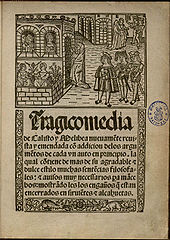
The 15th century may be thought of as a pre-Renaissance period. Literary production increases greatly. Outstanding poets of this century include Juan de Mena and Íñigo López de Mendoza (Marquess of Santillana). Spanish literature of the Middle Ages concludes with La Celestina by Fernando de Rojas.
Important Renaissance themes are poetry, with Garcilaso de la Vega and Juan Boscán; religious literature, with Fray Luis de León, San Juan de la Cruz, and Santa Teresa de Jesús; and prose, with the anonymous El Lazarillo de Tormes. Amidst the principal features of the Renaissance were the revival of learning based on classical sources, the ascension of courtly patronage, the development of perspective in painting, and advances in science. The nigh of import characteristics of the Renaissance are:
- The prevalence of natural, elementary language, fugitive affectation, amaneramiento and the over-refined phrase, producing simple vocabulary and straightforward syntax.
- Themes such as love - conceived from the platonic signal of view; nature - as somewhat idyllic (bucolic); infidel mythology - concerned with female person dazzler and the histories of the gods, following always the same classical platonic. In relation to these themes, various Renaissance points exist (???) some of them taken from the classical earth:
- Carpe Diem, ("seize the solar day" or "have reward of the moment"), which recommends the enjoyment of life before the arrival of sometime age.
- Collige, virgo, rosas which literary ways "Pick virgin the roses" and is a metaphor similar to Carpe Diem just practical to female beauty, described always following the same program: a young blonde, with serene, clear eyes, white peel, red lips, rosy cheeks, etc.
- The Beatus Ille or praise of rural life, away from fabric things, as opposed to life in the city, with its dangers and intrigues.
- The Locus Amoenus or description of nature in all its idyllic perfection.




Bizarre [edit]
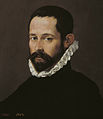
In the Baroque of the 17th century of import topics are the prose of Francisco de Quevedo and Baltasar Gracián; the theater is notable (Lope de Vega, Pedro Calderón de la Barca, and Tirso de Molina); and poetry with Luis de Góngora (who is a Culteranist) and Francisco de Quevedo (who is a Conceptist). In the works of Miguel de Cervantes Saavedra notable novels are La Galatea and Don Quixote de la Mancha. The Bizarre mode used exaggerated motion and clear, easily interpreted detail to produce drama, tension, exuberance, and grandeur in sculpture, painting, literature, dance, and music.
The Baroque is characterized by the following points:
- Pessimism: The Renaissance had not achieved its purpose of imposing harmony and perfection in the globe, as the humanists intended, nor had it made human being happier; wars and social inequality continued to be present; pain and calamities were commonplace throughout Europe. An intellectual cynicism took concur, which increased every bit fourth dimension passed. This was shown by the angry character of the comedies of that epoch, and past rascal characters on which the picaresque novels are based.
- Disillusionment: As the Renaissance ideals failed, and, in the case of Spain, political power was being dispelled, disillusionment continued to arise in literature. Many cases recall those of two centuries before, with the Danza de la Muerte or Manrique'due south Coplas a la muerte de su padre. Quevedo said that life is formed past "successions of deceased". Newborns plow into the deceased, and diapers into the shroud that covers lifeless bodies. This leads to the decision that aught is important except obtaining eternal salvation.
- Worry about the passing of time.
- Loss of conviction in the Renaissance ideals.





Enlightenment [edit]

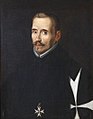
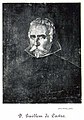
In the Enlightenment of the 18th century, with the arrival of "the lights" to Spain, important topics are the prose of Fray Benito Jerónimo Feijoo, Gaspar Melchor de Jovellanos, and José Cadalso; the lyric of the Salmantine school (with Juan Meléndez Valdés), the lyric of the Madrilenian group (with the story-tellers Tomás de Iriarte and Félix María Samaniego), and the lyric of the Sevillian school; and also the theater, with Leandro Fernández de Moratín, Ramón de la Cruz and Vicente García de la Huerta. Enlightenment thinkers sought to apply systematic thinking to all forms of homo activity, conveying it to the upstanding and governmental spheres in exploration of the individual, gild and the state.
3 phases in the Spanish literature of the 18th century are distinguished:
- Anti-Baroquism (until approximately 1750): It fights confronting the style of the preceding Bizarre, which is considered excessively rhetorical and twisted. The recreational literature is not cultivated, but they are more interested in the essay and satire, utilizing the language with simplicity and purity.
- Neoclassicism (until the end of the 18th century): It is strongly influenced by French and Italian classicism. The writers also imitate the sometime classics (Greek and Roman); its blast extended since the reign of Fernando Half-dozen until the terminate of the century.
- Pre-Romanticism (cease of the 18th and beginning of the 19th century): The influence of the English philosopher John Locke, together with that of the French Étienne Bonnot of Condillac, Jean-Jacques Rousseau, and Denis Diderot, volition cause a new feeling, dissatisfaction with the tyranny of reason, that emphasizes the right of the individuals to express their personal emotions (repressed then by the neoclassicals), amongst which figures fundamentally love. This current announces the refuse of Neoclassicism and opens the door to Romanticism.
Romanticism [edit]
Early on Romanticism appeared with the singular effigy of Manuel José Quintana.

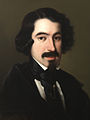
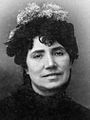
In Romanticism (start of the 19th century) of import topics are: the poetry of José de Espronceda and other poets; prose, which can take several forms (the historical novel, scientific prose, the description of regional customs, journalism —where Mariano José de Larra can be mentioned—; the theater, with Ángel de Saavedra (Duke of Rivas), José Zorrilla, and other authors. In the latter romanticism (post-romanticism) some appear:Gustavo Adolfo Bécquer and Rosalía de Castro. Some anti-romantic poets are Ramón de Campoamor and Gaspar Núñez de Arce. In part a revolt confronting aristocratic, social, and political norms of the Enlightenment catamenia and a reaction against the rationalization of nature, in art and literature Romanticism stressed strong emotion every bit a source of aesthetic feel, placing new emphasis on such emotions as trepidation, horror, and the awe experienced in against the sublimity of nature. It elevated folk art, nature and custom.
The characteristics of the works of Romanticism are:
- Rejection of Neoclassicism. Opposite to the scrupulous severity and order with which the rules were observed in the 18th century, the romanticist writers combine the genres and verses of unlike measures, at times mixing verse and prose; in theater, the rule of the three units (place, space and fourth dimension) is despised and they alternate comedy with drama.
- Subjectivism. Whatever kind of piece of work it is, the exalted soul of the author pours into it all his feelings of dissatisfaction against a world that limits and breaks the flight of his desire virtually honey, lodge, patriotism, etc. They do and then in such a manner that nature fuses with their state of spirit and it is melancholic, tetric, mysterious, nighttime... as opposed to the neoclassicals, who barely showed interest in the landscape. The longings for passionate love, desire for happiness, and possession of the space, cause a discomfort in the romanticist, an immense deception that from time to time carries them to suicide, as is the example of Mariano José de Larra.
- Attraction to the nocturnal and mysterious. The romantics situate their agonized and disillusioned feelings in mysterious or melancholic places, such equally ruins, forests, cemeteries... Similarly they experience an attraction toward the supernatural, things that escape any logic, such as miracles, apparitions, visions of the afterlife, the diabolic and the witchlike...
- Escape from the world that surrounds them. Rejection of the conservative society in which they are forced to alive makes the romanticist be evaded from his circumstances, imagining passed epochs in which their ideals prevailed over the others, or beingness inspired in the exotic. In contrast with the neoclassicals, who admired the Greco-Latin antiquity, the romanticists adopt the Middle Ages and the Renaissance. Among their more frequent kinds of works, they cultivate the novel, legend and historic drama.
Various are the themes of the romanticist works:
- Oneself. In Espronceda's Song to Teresa, a heartwrenching confession of dearest and disillusion, he has managed to poeticize his feelings with great success.
- Passionate dear, with sudden, total deliveries and quick abandonments. Exaltation and distaste.
- They are inspired in legendary and historic themes.
- Faith, although information technology is often in disobedience of the consequent compassion and fifty-fifty exaltation of the devil.
- Social demands (revaluation of marginalized types, such as the beggar).
- Nature, shown in all its modalities and variations. Unremarkably set in mysterious places, such every bit cemeteries, storms, the rough bounding main, etc.
- Satire, connected with political or literary events.


Realism [edit]


In Realism (finish of the 19th century), which is mixed with Naturalism, of import topics are the novel, with Juan Valera, José María de Pereda, Benito Pérez Galdós, Emilia Pardo Bazán, Leopoldo Alas (Clarín), Armando Palacio Valdés, and Vicente Blasco Ibáñez; poetry, with Ramón de Campoamor, Gaspar Núñez de Arce, and other poets; the theater, with José Echegaray, Manuel Tamayo y Baus, and other dramatists; and the literary critics, emphasizing Menéndez Pelayo. Realism offered depictions of contemporary life and club 'as they were'. In the spirit of general "Realism," Realist authors opted for depictions of everyday and banal activities and experiences, instead of a romanticized or similarly stylized presentation.
The realistic works of this period are characterized by:
- Objective vision of reality through the direct observation of customs or psychological characters. They eliminate any subjective aspect, fantastic events, and every feeling that moves away from reality: "The novel is the prototype of life" (Galdós), "an creative copy of reality" (Clarín).
- Defense of a thesis: the narrators write their works approaching reality from their moral conception. They are the so-called all-seeing narrators. The defense of a thesis normally compromises the objectivity of the novel.
- Themes that are familiar to the reader: marital conflicts, infidelity, defense of ideals, etc.
- The pop and colloquial language acquires great importance since it situates the characters in their real environment.
Modernist literature [edit]

In Modernism several currents appear: Parnasianism, Symbolism, Futurism, and Creationism. Literary Modernism in Espana was influenced by the "disaster of '98", Regenerationism, and the Costless Institution of Education (founded by Giner de los Ríos). Modernism was rooted in the thought that "traditional" forms of art, literature, religious organized religion, social organization, and daily life had become outdated; therefore information technology was essential to sweep them bated. The intellectual motility that thinks objectively and scientifically nigh the causes of the decadence of Kingdom of spain as a nation betwixt the 19th and the 20th century is chosen Regenerationism. Information technology expresses a pessimist judgement about Spain. The regenerationist intellectuals divulgated their studies in journals with a big diffusion, and then the movement expanded. Some important Modernist authors are Salvador Rueda, Juan Ramón Jiménez, Miguel de Unamuno and Rubén Darío.
20th century literature [edit]
The Generation of 1898 [edit]
The destruction of Spain's fleet in Cuba by U.South. gunboats in 1898 provoked a general cultural crisis in Espana. The "Disaster" of 1898 led established writers to seek practical political, economic, and social solutions in essays grouped under the literary heading of "Regeneracionismo". For a grouping of younger writers, among them Miguel de Unamuno, Pío Baroja, and José Martínez Ruiz (Azorín), the Disaster and its cultural repercussions inspired a deeper, more radical literary shift that afflicted both form and content. These writers, along with Ramón del Valle-Inclán, Antonio Machado, Ramiro de Maeztu, and Ángel Ganivet, came to be known every bit the "Generation of 98". The label from its outset was controversial and even Azorín, the source of its origin, came to reject it. Even so, information technology stuck every bit a way to depict a grouping of writers who turned in content from the more full general exploration of universal middle form values characteristic of Nineteenth Century Realism to an obsession with questions of a more national nature. Their articles, essays, poems, and novels exploring Spanish history and geography carried existential overtones, expressing overall a sense of deep malaise at the social injustice, political bungling, and cultural indifference axiomatic in gimmicky Spanish order.
Inside a matter of years, these young authors had transformed their nation'south literary landscape. To exist sure, established nineteenth century realists, such equally Benito Pérez Galdós, continued to write novels and theater into the second decade of the twentieth century, and, again in the case of Galdós, were much admired past the new generation of writers. Nonetheless, with the novels of Unamuno, Azorín, Pío Baroja, and Valle Inclán, the theater of the latter, and the poetry of Antonio Machado and Unamuno, a definitive literary shift had taken place—a shift in both form and content—pointing towards the more celebrated experimental writings of Spain's vanguard writers of the 1920s.
Thanks to Azorín'south designation of his fellow writers equally a "generation", contemporary critics and later literary historians were to catalogue and then translate the arrival of new batches of authors in such generational terms for about the adjacent one hundred years. Certainly, the terminology possesses a certain organizational elegance and indeed, recognizes the significant impact of major political and cultural events on changing literary expressions and tastes (for example, the 1898 connection, or a 1927 literary celebration that briefly united virtually every major vanguard poet in Kingdom of spain).
The Generation of 1914 or Novecentismo [edit]
The adjacent supposed "generation" of Spanish writers following those of ´98 already calls into question the value of such terminology. Past the year 1914—the year of the outbreak of the Beginning Earth War and of the publication of the first major piece of work of the generation'due south leading voice, José Ortega y Gasset—a number of slightly younger writers had established their own place within the Spanish cultural field. Leading voices include the poet Juan Ramón Jiménez, the academics and essayists Ramón Menéndez Pidal, Gregorio Marañon, Manuel Azaña, Eugeni d'Ors, and Ortega y Gasset, and the novelists Gabriel Miró, Ramón Pérez de Ayala, and Ramón Gómez de la Serna. While still driven by the national and existential questions that obsessed the writers of ´98, they approached these topics with a greater sense of distance and objectivity. These writers had enjoyed more than formal bookish training than their predecessors, many taught within the walls of academia, and i, Azaña, was to go President and face up of the Second Republic. Their genre of selection were the essay and the article, their arguments more systematic, and their tastes, more European.
In contrast to Unamuno's existential obsessions or Machado's conceptual, globe-bound verse, Juan Ramón'due south verse pursued a more esoteric version of beauty and truth above all, while still manifesting an internalized sense of the existential dilemmas that plagued intellectuals in the offset half of the twentieth century. Juan Ramón was Spain's bully modernist poet and the maestro of the coming vanguardist Generation of 1927. In 1957 he was awarded the Nobel Prize for literature. José Ortega y Gasset became the spokesman for this and essential every generation of writers in the first one-half of the twentieth century. In essays similar "Meditations on the Quijote," "The Rebellion of the Masses," and near famously, "The Dehumanization of Fine art," Ortega laid out theories of art and society that lucidly explained and celebrated twentieth century vanguard experimentation while property fast to an elitist social vision whose eclipse this art ironically expressed. The about elusive voice of this generation, and arguably, unclassifiable inside this group was the novelist Ramón Gómez de la Serna who carried the narrative experiments of Unamuno and Valle Inclán to absurd extremes, such as in his 1923 novel, El novelista, where varieties of plays with narrative subjectivity result in chapters envisioned through the eyes and vocalisation of street lamps. More than approachable and enduring are Gómez de la Serna's "Greguerías," an original form of aphorism that he described as "sense of humour plus metaphor."
The Generation of 1927 [edit]
Around 1920 a younger grouping of writers—more often than not poets—began publishing works that from their beginnings revealed the extent to which younger artists were absorbing the literary experimentation of the writers of 1898 and 1914. Poets Pedro Salinas, Jorge Guillén, Federico García Lorca, Vicente Aleixandre, Dámaso Alonso, Manuel Altolaguirre were likewise the most closely tied to formal academia withal. Novelists such as Benjamín Jarnés, Rosa Chacel, Francisco Ayala, and Ramón J. Sender were as experimental and academic. Many of this generation were full-time academy professors, while others spent periods as guest teachers and students. All were scholars of their national literary heritage, over again bear witness of the bear on of the calls of "Regeneracionistas" and the Generation of 1898 for Spanish intelligence to turn at to the lowest degree partially inwards.
This grouping of poets continues to exist, without competition, the near celebrated and studied of Espana's twentieth century writers. Their work provides a capstone to what some have called the "Silver Age" of Castilian Letters, a flow that began with the veritable explosion of novel production following the bloodless coup of 1868 and that would come to a tragic finish with the outbreak of ceremonious war in July 1936.
The writing of this supposed generation can be roughly divided into iii moments. In their early on years their piece of work arises nonetheless out of mostly local and national traditions, culminating in their united celebration of the tri-centennial of the death of Gold Age poet Luis de Góngora. From mid decade until the arrival of Spain'south Second Democracy in 1931, the Generation'due south poets reached the apex of their experimental writings, manifesting a clear awareness of the international vanguard "—isms" sweeping major Western capitals of the day. After 1931, the Generation'south writing increasingly displays the banner of the political and social stresses that would lead to Spain's encarmine civil war.
The Spanish Civil War [edit]
The Spanish Civil War, lasting from July 1936 to April 1939, had a devastating affect on the trajectory of Spanish letters. In July 1936, Spain was at the height of its Silver Age. Every major writer of the three major generations—1898, 1914, and 1927—was still alive and productive. Those of 1914 and 1927 were at the meridian or just reaching the summit of their literary powers. Several were recognized among Western culture's most talented and influential writers. Simply by April 1939, Miguel de Unamuno, Antonio Machado, and Federico García Lorca, among others, were expressionless. All but a modest handful of the remaining writers had fled into exile, dispersed across the length of the American continent, virtually never to enjoy the shut associations of conferences, tertulias, and theater premiers that had so often united them in pre-war Madrid.
Among the handful of civil war poets and writers, Miguel Hernández stands out. A young disciple and acquaintance of the Generation of 1898, Hernández, like Lorca, became a martyr to the Republican cause but this time as a mail service-war prisoner, fighting and writing as a soldier poet throughout the state of war and then languishing and dying in ane of Franco's prisons in 1942. Amidst his of import works, Perito en lunas (1933) from his pre-war surrealist days and Viento del pueblo (1937), evidence of the work of a soldier-poet, stand out.
Witnessing the early on dictatorship (1939–1955) [edit]
The primeval years of the post-war were characterized more by hunger, repression, and suffering than by whatever significant literature. The published works of this period were truthful to pseudo-fascist dictator Francisco Franco's reactionary vision of a second Spanish aureate age than to the material and existential anguish facing the majority of the country's population of the time. Neo-bizarre poetry and paeans to Franco's Espana satisfied the censors but has enjoyed no subsequent disquisitional shelf-life.
Ironically, the narrative production of 1 of Franco's censors would provide the first sign of literary revival in mail-state of war Kingdom of spain. In 1942, Camilo José Cela's novel, La familia de Pascual Duarte , used just enough experimental arrangement (temporally disjointed narrative development to problematize simple accusations of political crusade-effect critique; prefaces and post-scripts that confuse authorial intentions) to avert the censors´ cuts and to nowadays to discerning Spanish readers an exposé of a spiritually troubled, socially impoverished, and structurally violent social club. Cela was to remain for the side by side five decades every bit ane of Spain's most of import novelists, eventually receiving the Nobel Prize for literature in 1989.
With the 1945 publication of the Nadal Prize winning Zero past Carmen Laforet and the 1947 release of Miguel Delibes's La sombra del ciprés es alargada , readers of intelligent Castilian narrative at last had crusade for hope. While the fresh, joyful experimentation of Spain's "Silver Age" writers had disappeared, Cela, Laforet, and Delibes at least showed a renewed commitment to a kind of writing that offset, was connected to Spain's material reality, and 2nd, would stretch itself aesthetically in its attempts to capture the experience.
Past the middle of the adjacent decade, a whole new generation of novelists was latching onto the early models laid downward past Cela and Laforet. Equally influenced past the films of the Italian neorealists, novelists such as Luis Romero ( La noria , 1951), Rafael Sánchez Ferlosio ( El jarama , 1956), Jesús Fernández Santos ( Los bravos , 1956), Carmen Martín Gaite ( Entre visillos , 1957), Ignacio Aldecoa ( El fulgor y la sangre , 1954), and Juan Goytisolo ( Juegos de manos , 1954) produced a social realist tradition that was equally historic as it was short-lived.
Spanish poetry experienced renewal forth similar lines. Dámaso Alonso's verse form, "Insomnia" (1947) captures much of the angst and sense of violence that informed the works of Cela et al. and that would infuse the Castilian verse of the era:
Madrid es una ciudad de más de un millón de cadáveres (según las últimas estadísticas).
A veces en la noche yo me revuelvo y me incorporo en este nicho en el que hace 45 años que me pudro,
y paso largas horas oyendo gemir al huracán, o ladrar los perros, o fluir blandamente la luz de la luna.
Y paso largas horas gimiendo como el huracán, ladrando como un perro enfurecido, fluyendo como la leche de la ubre caliente de una gran vaca amarilla.
Y paso largas horas preguntándole a Dios, preguntándole por qué se pudre lentamente mi alma,
por qué se pudren más de un millón de cadáveres en esta ciudad de Madrid,
por qué mil millones de cadáveres se pudren lentamente en el mundo.
Dime, ¿qué huerto quieres abonar con nuestra podredumbre?
¿Temes que se te sequen los grandes rosales del día, las tristes azucenas letales de tus noches?
Poems by José Hierro, Blas de Otero, and Gabriel Celaya were more direct, penning poems with such transparent titles as Canto a España (Hierro), A la inmensa mayoría (Otero), or La poesía es united nations arma cargada de futuro (Celaya).
Economic and cultural renewal (1955–1975) [edit]
However, by the mid-1950s, just as with the novel, a new generation which had simply experienced the Spanish ceremonious war in childhood was coming of historic period. While still informed by the material social and political weather condition of Spanish gild, the works of Ángel González, Claudio Rodríguez, José Ángel Valente, José Agustín Goytisolo, Francisco Brines, and Gloria Fuertes among others are less politically committed. Scholars differentiate these poets´ social focus as one of advice of feel versus Hierro's and Celaya's representation of experience. That is, while these younger poets were notwithstanding interested in talking about Spain, they were at least every bit focused on the interactive processes of communication with the reader who was contemporaneously living these experiences. Rather than passively ingest the poet'southward vision of contemporary society, the poets of what came to be called variously the generation of 1956 or "of the 1960s" produced poesy that engaged the reader in the interpretation if not the production of that vision.
By the early on 1960s, the cursory social realist flare-up in narrative was already growing stale. Numerous novelists took a brief hiatus from writing. The full general consensus every bit a new decade began was that the straightforward "realism" of the previous decade, while manifesting the savage "truth" of gimmicky Spanish life under Franco, ultimately failed politically in that it directly modeled the very transparent soapbox used so effectively past the authoritarian regime to crush the very opposition to which these writers aspired. Shaped in part past the French "nouveau roman" of writers like Alain Robbe-Grillet, the French "La Nouvelle Vague" cinema of Godard and Truffaut, and Latin American "Boom", Spanish novelists and poets, beginning perhaps with Luis Martín Santos's novel, Tiempo de silencio (1961), returned to the restless literary experimentation last seen in Spanish messages in the early on 1930s. Amongst Espana'due south most historic "New Novels" of this period, Juan Benet'south Volverás a Región (1967), Camilo José Cela'due south San Camilo, 36 (1969), Miguel Delibes's Cinco horas con Mario (1966), Juan Goytisolo's and so called "Trilogy of Treason" consisting of Señas de identidad (1966), Reivindicación del conde Don Julián (1970), and Juan sin tierra (1975), Gonzalo Torrente Ballester'south La saga/fuga de J.B. (1972), Juan Marsé'southward Si te dicen que caí (1973), and Luis Goytisolo'south tetralogy Antagonía (1973–1981) stand out. While arguably pulling Spanish narrative past the collar from the relative dark of social realism towards the aesthetic standards of Europe'south most aristocracy avant-garde, many of these novels proved almost unreadable to much of the public, a reality nicely embodied at the stop of Juan Goytisolo's trilogy when an already deconstructed Spanish prose gradually transforms into an unreadable Arabic.
The novel'southward experimentation was shadowed in Spanish poesy. José María Castellet's publication of Nueve novísimos poetas españoles recognized a group of artists whose works had similarly returned to early century experimentation. The works of Pere Gimferrer, Guillermo Carnero, and Leopoldo Panero, arguably the well-nigh of import poets of the group, manifest a decidedly bizarre fashion full of oblique cultural references, metapoetic devices, and other forms of extreme poetic self-consciousness spilling into the precious. Like the works of the New Novelists, this poetry was for a select group of readers, if non sectional to the poets themselves.
Writing in the democracy (1975–1999) [edit]
When Franco at last died in November 1975, the important work of establishing democracy had an immediate impact on Spanish letters. Elitist narrative and poetry quickly gave mode to narrative and poetry interested afresh in non only teaching (via content or manner) but in delighting. Storytelling became the mantra for a new generation of Spanish novelists. Eduardo Mendoza'southward La verdad sobre el caso Savolta (1975) invited readers to escape to the roaring 1920s of Spain'due south pre-political, culturally vibrant Silver Age. While availing itself of various "New Novel" experiments such as narrative fragmentation, the use of mixed media, and the presence of numerous often contradictory narrative voices, Mendoza'due south novel could be read and enjoyed as an adventure story with romantic and dramatic appeal.
Carmen Martín Gaite's 1978 novel, El cuarto de atrás, was another manifestation of the happy melding of experiment with old-fashioned storytelling, pulling readers down through various narrative levels to explore dark memories of Espana's contempo political past but with the lite, ironic touch on of a romance novel. Over the side by side several years a wealth of immature new writers, amongst them Juan José Millás, Rosa Montero, Javier Marías, Luis Mateo Díez, José María Merino, Félix de Azúa, Cristina Fernández Cubas, Enrique Vila-Matas, Carme Riera, and later Antonio Muñoz Molina and Almudena Grandes, would begin carving out a prominent identify for themselves within the Spanish cultural field. During the 1980s, Spanish narrative began appearing regularly on best seller lists for the first fourth dimension since the pre-state of war era and many of this new generation became literary and cultural celebrities, living off their piece of work as writers with all its blessing and curses, including the obligation to publish or perish.
By the 1990s, the force per unit area to produce for the big publishing houses was clearly diminishing the early literary promise of some of these writers. On the other hand, some like Javier Marías, after publishing since the early 1970s, finally achieved international fame, actualization on best-seller lists throughout Europe. Marías's novels Corazón tan blanco (1992) and Mañana en la batalla piensa en mí (1994), and his ever-expanding experiment with real fiction (begun with 1989'south Todas las almas and continued through weekly paper columns, 1998's Negra espalda del tiempo, and extended in his 21st century trilogy, Tu rostro mañana), placed him on numerous critics´ Nobel Prize shortlists.
The large money bachelor through novel publishing manifest itself in the 1990s in the explosion of literary prizes, awarded in Spain, dissimilar the UK'southward Man Booker or the U.S.´s Pulitzer, to unpublished works. Literary prizes became footling more than than publicity opportunities. The long-standing Planeta and Nadal prizes, already media events, grew in importance and remuneration. They were joined during the decade past the Primavera, Alfaguara, and Lara Prizes, the return of the Café Gijón and the Biblioteca Breve prizes. Most carried big sums for the winners and guaranteed—ofttimes obligated—long international volume tours.
Into this economically charged mix stepped two new phenomena, the literary superstar and the literary celebrity. The one-time is near entirely embodied by announcer turned novelist Arturo Pérez Reverte who has managed to merit a certain disquisitional acclaim while topping the sales charts with about every novel he writes. Many of his novels have been converted into popular films. A lesser figure as far as novel sales, just still of import to the overall industry is the literary glory. These celebrities range from politically powerful figures similar Antonio Muñoz Molina and Jon Juaristi to cursory media flashes like Ray Loriga, José Ángel Mañas, and Lucía Etxchebarría. The latter three were the most representative members of the concluding of the twentieth century's supposed literary "generations." The "Generación X," as critics dubbed them, brought black humor to a certain kind of post-political social realism focused principally on sex, drugs, rock-north-coil and the mental illness that accompanies it. These writers proved an excellent marketing miracle. That their works will suffer is doubtful.
New novelists whose work is more likely to endure that began publishing in this period include Rafael Chirbes, Belén Gopegui, David Trueba, the Basques writers Bernardo Atxaga and Álvaro Bermejo, the Galician'south Manuel Rivas and Suso de Toro among others. In the final decade of the 1990s, and then, arguably five generations of writers—from Cela, to Sánchez Ferlosio, to Mendoza, to Muñoz Molina, to the Generation X authors—were sharing the expanding literary space of Castilian narrative. Even so the plethora of prize coin that threatened to drown out quality with media-generated noise, the Spanish literary field at the terminate of the twentieth century was every bit promising as information technology had been since the 1920s.
Gimmicky literature [edit]
Javier Marías is widely considered as the most distinguished author in contemporary Spanish literature. Other acclaimed and widely read writers both nationally and internationally are Enrique Vila-Matas, Rosa Montero, Antonio Muñoz Molina, as well every bit more commercial authors like Carlos Ruiz Zafón. In recent years authors such as Elvira Navarro and Javier Cercas have published acclaimed best-selling novels.[6] [7]
Outline [edit]
- Middle Ages
- Epics:
- The Lay of the Cid
- Poema de Fernán González
- Mocedades de Rodrigo
- Alfonso X
- Juan Ruiz (Libro de buen amor)
- Gonzalo de Berceo (Milagros de Nuestra Señora)
- Jorge Manrique (Coplas a la muerte de su padre)
- Epics:
- Renaissance and Baroque (Siglo de oro)
- The classical prose
- Bearding (Lazarillo de Tormes)
- Fernando de Rojas (La Celestina)
- Alonso de Ercilla (La Araucana)
- Bernal Díaz del Castillo (Historia verdadera de la conquista de la Nueva España)
- Bernardino de Sahagún (Historia General de las cosas de la Nueva España)
- Mateo Alemán (Guzmán de Alfarache)
- Baltasar Gracián (El Criticón)
- Miguel de Cervantes (Don Quixote, Novelas ejemplares)
- The classical Castilian theater
- Juan del Encina
- Lope de Rueda
- Guillén de Castro (Las Mocedades del Cid)
- Lope de Vega (El perro del hortelano, Fuenteovejuna)
- Pedro Calderón de la Barca (La vida es sueño)
- Tirso de Molina (El burlador de Sevilla)
- Juan Ruiz de Alarcón
- Spanish classical poetry
- Garcilaso de la Vega
- Juan Boscán
- Fray Luis de León
- Luis de Góngora
- Francisco de Quevedo
- Saint John of the Cross
- Saint Teresa of Ávila
- Philosophy
- Francisco de Vitoria
- Juan Luis Vives
- Antonio de Nebrija (Gramática Castellana)
- Gómez Pereira
- Bartolomé de las Casas (Brevísima relación de la destrucción de las Indias)
- Francisco Suárez
- Luis de Molina
- The classical prose
- The 18th century
- Neoclassical prose
- José Cadalso (Cartas marruecas, Noches lúgubres)
- Benito Jerónimo Feijoo
- José Francisco de Isla
- Gaspar Melchor de Jovellanos
- Noeclassical poetry
- Tomás de Iriarte (Fábulas literarias)
- Juan Meléndez Valdés
- Félix María de Samaniego
- Neoclassical theater
- Vicente García de la Huerta (Raquel)
- Leandro Fernández de Moratín (El sí de las niñas)
- Neoclassical prose
- The 19th century
- Romanticists
- Romantic Prose
- Juan Donoso Cortés
- Mariano José de Larra
- Marcelino Menéndez Pelayo
- Romantic verse
- Manuel José Quintana
- Gustavo Adolfo Bécquer (Rhymes, Legends)
- José de Espronceda (El estudiante de Salamanca, La canción del pirata)
- Rosalía de Castro
- Romantic theater
- Adelardo López de Ayala
- Antonio García Gutiérrez (El trovador)
- Juan Eugenio Hartzenbusch (Los amantes de Teruel)
- Francisco Martínez de la Rosa (La conjuración de Venecia)
- Duque de Rivas (Don Álvaro o la fuerza del sino)
- José Zorrilla (Don Juan Tenorio)
- Romantic Prose
- Realists
- Benito Pérez Galdós (Fortunata y Jacinta, Episodios Nacionales, Misericordia)
- Leopoldo Alas, Clarín (La Regenta, Su único hijo)
- Vicente Blasco Ibáñez (Arroz y tartana, Los cuatro jinetes del Apocalipsis)
- Emilia Pardo Bazán (Los pazos de Ulloa)
- Enrique Gaspar y Rimbau (El anacronópete)
- Pedro Antonio de Alarcón (El sombrero de tres picos)
- Armando Palacio Valdés (La hermana San Sulpicio)
- José María de Pereda (Sotileza)
- Juan Valera (Pepita Jiménez, Juanita la Larga)
- Concepción Arenal
- Romanticists
- The 20th century
- Generation of 98
- Prose
- Ángel Ganivet
- Pío Baroja (The Tree of Knowledge)
- Miguel de Unamuno (Mist)
- José Martínez Ruiz, Azorín
- Poetry
- Antonio Machado (Soledades, Campos de Castilla)
- Manuel Machado
- Mario Satz
- Theater
- Jacinto Benavente (Los intereses creados)
- Ramón del Valle-Inclán (Luces de bohemia, Martes de Carnaval)
- Prose
- Generation of 27
- Rafael Alberti (Marinero en tierra)
- Vicente Aleixandre
- Dámaso Alonso (Hijos de la ira)
- Manuel Altolaguirre
- Luis Cernuda
- Gerardo Diego
- García Lorca (Yerma, La casa de Bernarda Alba)
- Jorge Guillén
- Leopoldo Panero
- Emilio Prados
- Pedro Salinas (La voz a ti debida)
- Miguel Hernández (El rayo que no cesa)
- Philosophy
- George Santayana
- María Zambrano
- José Ortega y Gasset (Meditaciones sobre el Quijote)
- Alexandre Deulofeu
- Julián Marias
- Fernando Savater
- Xavier Zubiri
- Eugenio d'Ors
- Prose
- Camilo José Cela (La colmena, La familia de Pascual Duarte)
- Fernando Fernán Gómez (El viaje a ninguna parte)
- Miguel Delibes (Cinco horas con Mario, Los santos inocentes)
- Gonzalo Torrente Ballester (Los gozos y las sombras)
- Manuel Vázquez Montalbán (Yo maté a Kennedy)
- Max Aub
- Salvador de Madariaga
- Poetry
- Ramón Gómez de la Serna (Greguerías)
- Jorge Semprún
- José Luis Cano
- José María Pemán
- Theater
- Santiago Rusiñol
- Alejandro Casona (La dama del alba)
- Antonio Buero Vallejo (Historia de una escalera)
- Manuel Azaña
- Fernando Arrabal
- Paloma Pedrero
- Generation of 98
Run across also [edit]
- Latin American literature
- Philippine literature in Spanish
- List of Castilian-linguistic communication authors
- List of Spanish-linguistic communication poets
- Catalan literature
- Galician-linguistic communication literature
- List of Astur language authors
- The Premio Cervantes prize is awarded to accolade the career of a writer in the Spanish language, regardless of nationality.
- José María Gironella
- Standard arabic literature, for literature produced in Islamic Spain
References [edit]
- ^ J.A. Garrido Ardila "A Concise Introduction to the History of the Spanish Novel" A History of the Spanish Novel, Oxford Academy Printing 2015
- ^ Linda Fish Compton: Review of Andalusian Lyrical Poetry and Old Spanish Love Songs: The "Muwashshah" and Its "Kharja." by Due south. G. Armistead", Hispanic Review, Vol. 46, No. i. (Winter, 1978), pp. 92-95 [1]: "The use of Mozarabic should not exist limited to "Christians and Jews living under Muslim rulers", since it is clear that near Hispano-Moslems also spoke [information technology]"
- ^ LIPSKI, John M.: "Review of El Mozarabe de Valencia by Leopoldo Penarroja Torrejon", International Journal of Eye E Studies.Vol. 24, No. three (Aug., 1992), pp. 519-521 [two]
- ^ CASTRO, Américo: "Mozarabic Verse and Castile", Comparative Literature. Vol. 4, No. 2 (Spring, 1952), pp. 188-189.[3]: "[...] The new-found Mozarabic poesy is non written in Castilian, and that therefore its existence cannot be used to prove that at that place was a lyric poetry in Castile"
- ^ "El escritor José de Espronceda". Museo del Prado (in Castilian). Madrid. Retrieved March 27, 2013.
- ^ Andrew Kingsford-Smith ten of the All-time Gimmicky Spanish Authors Civilization Trip xviii December 2018
- ^ Borja Hermoso What they're reading in Spain The Guardian 28 March 2011
- Pattison, Walter and Donald Bleznick (1971). Representative Spanish Authors: Book I (3 ed.). ISBN0-19-501326-3.
- Bleznick, vol II (1971). Representative Spanish Authors, Vol. II (3 ed.). Oxford University Press, Inc. ISBN0-nineteen-501433-2.
- Gies, David T. (Ed.). The Cambridge History of Spanish Literature. Cambridge University Press, 2008. ISBN 0-521-80618-6.
External links [edit]
- La biblioteca virtual "Miguel de Cervantes" Online Spanish literature texts.
- Palabra virtual Latin American Verse.
weinsteinwastfultaint.blogspot.com
Source: https://en.wikipedia.org/wiki/Spanish_literature
0 Response to "Forms of Art Literature Religious Faith and Social Organization"
Post a Comment